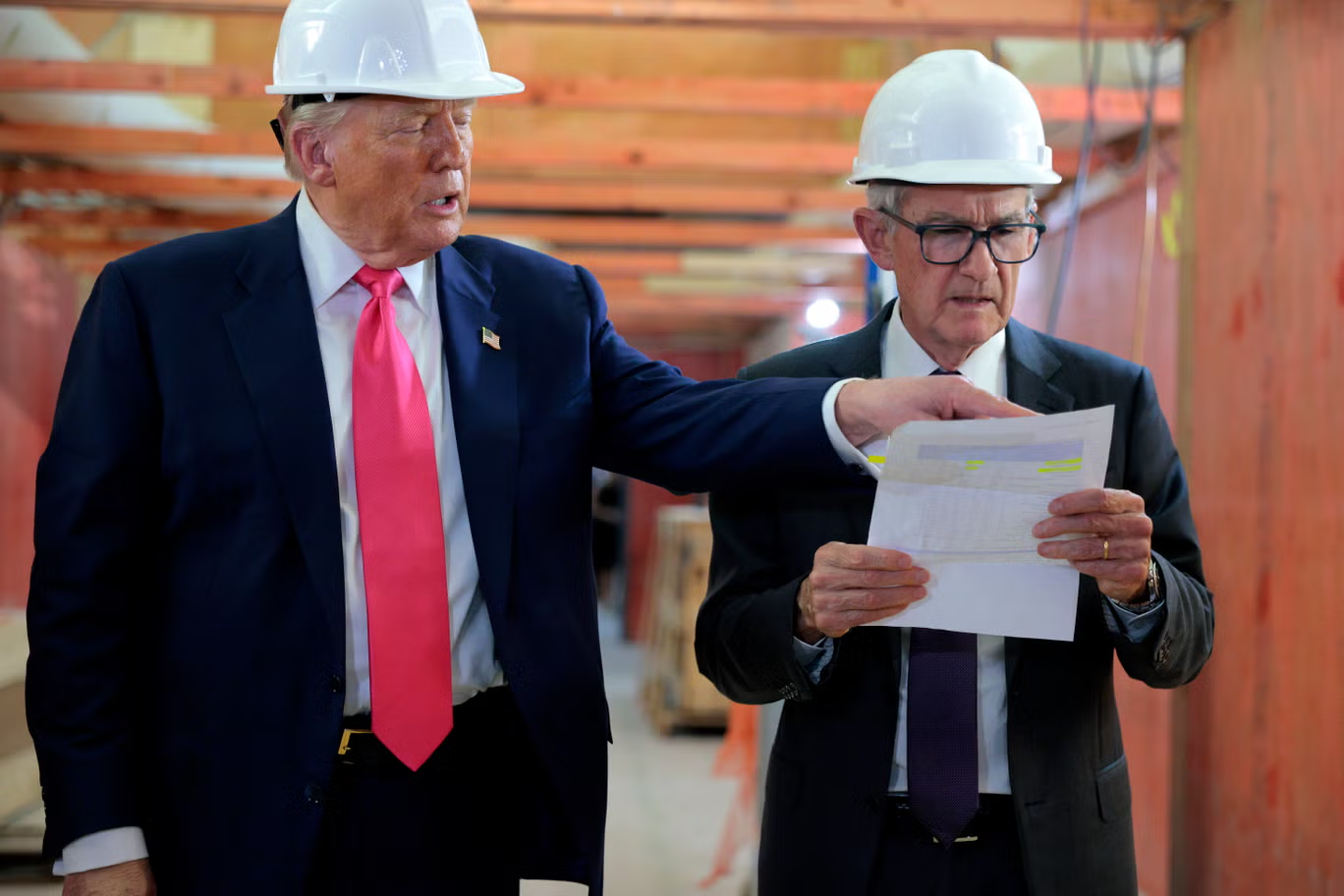
The investigation by Trump’s federal prosecutor against Federal Reserve Chairman Jerome Powell, and the potential criminal charges against him, are drawing sharp opposition from Republicans. They could use this to block President Donald Trump’s attempts to pressure Powell and the central bank into artificially lowering interest rates before the midterm elections.
Senator Lisa Murkowski of Alaska criticized the Justice Department’s investigation in an article published Monday on the website X. She stated that she had spoken with Powell about the Justice Department’s issuance of subpoenas against the central bank. These subpoenas suggest that prosecutors are seeking Powell’s testimony regarding a long-standing renovation project that Trump and his allies accuse of having been mismanaged during his presidency.
The senator said her conversation with Powell confirmed to her that the investigation was “clearly” an attempt at coercion.
Murkowski added: “If the Justice Department believes that an investigation into Federal Reserve Chairman Jerome Powell is justified by cost overruns—which are not exceptional—then Congress should investigate the Justice Department.” She added: “The risks are too great to ignore: if the Federal Reserve loses its independence, the stability of our markets and the economy as a whole will be affected.”
The Alaska senator’s condemnation of the sudden investigation into Powell came less than 24 hours after a scathing statement from her Republican colleague, North Carolina Senator Thom Tillis, criticizing the Trump administration for its “relentless pursuit of ending the independence of the Federal Reserve.”
Tillis added, “The independence and credibility of the Justice Department are now in question.”
The Republican senator from North Carolina, a member of the Senate Banking Committee, also stated that he would refuse to vote on any Trump nomination to head the Fed—including to replace Powell when her term expires in May—until the investigation is “finally closed.”
Senator Elizabeth Warren, the leading Democrat on the Senate Banking Committee, criticized the investigation led by Jerome Powell, calling it an example of how Trump is “openly using the Justice Department” to “take control of the Federal Reserve as quickly as possible and make policy decisions to his advantage before the 2026 election.”
The Justice Department investigation, overseen by Jeanine Pirro, a Trump ally and former Fox News host, was revealed this weekend after prosecutors subpoenaed the central bank. They wanted to hear Powell’s testimony before the Senate Banking Committee, testimony he had already given in June regarding the renovation of the Federal Reserve headquarters.
Trump, who told reporters aboard Air Force One that he was unaware of the investigation until questioned about it Sunday night, cited the renovation project as a possible reason for Powell’s firing, calling the $60 million cost overrun “very, very shameful” during a July press briefing. The Federal Reserve attributed the project’s $2.5 billion in additional costs to inflation and the need for expensive asbestos removal work that was not initially anticipated.
Kevin Hassett, a member of the National Economic Council, a close Trump ally, and the leading candidate to succeed Powell as Federal Reserve chairman, told CNBC on Monday that the investigation was a perfectly normal procedure, similar to the work done by internal oversight bodies, such as inspectors general.
He added, “It is the government’s duty to be subject to scrutiny and to have its work checked for integrity.” I believe this is an integral part of the government’s role, both at the national level and at the Federal Reserve level.
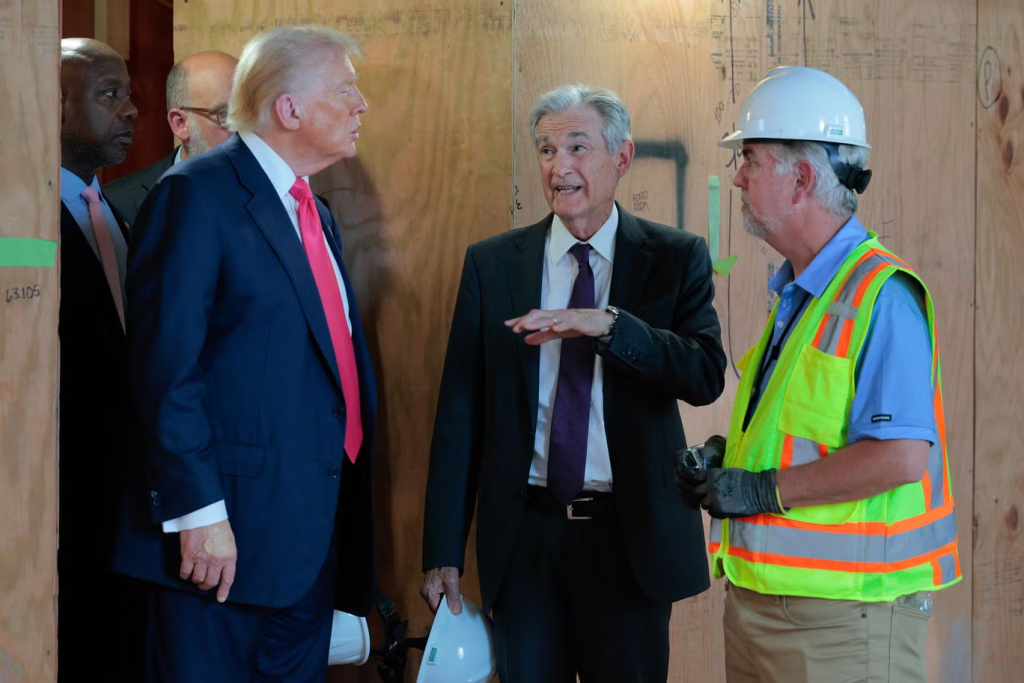
For his part, Jerome Powell confirmed the existence of the investigation in an unprecedented video statement, specifying that it was unrelated to his testimony before Congress or the renovations to the Federal Reserve headquarters.
“This is about whether the Fed will be able to continue setting interest rates based on data and economic conditions, or whether its monetary policy will be subject to political pressure or intimidation,” Powell said.
The announcement of the investigation targeting Powell is the latest episode in a year-long campaign by Trump to pressure the central bank’s board of governors to stimulate the American economy by drastically lowering interest rates. These rates had been raised for years under the Biden administration in an attempt to combat the runaway inflation that followed the pandemic.
For months, Mr. Trump has verbally attacked Mr. Powell, notably calling him a “latecomer” and repeatedly threatening to use the scandal surrounding the Federal Reserve’s renovations as a pretext to fire him.
Mr. Trump has also claimed to have fired another member of the Federal Reserve Board, Lisa Cook, appointed by Mr. Biden, based on allegations of real estate fraud brought against her by Bill Bolt, head of the Federal Housing Finance Agency.
The Supreme Court is scheduled to hear arguments this week in a lawsuit that will determine whether Trump can remove Cook. If his administration prevails, Trump could appoint one of his successors to the bank’s board.
The president has publicly expressed his desire for the Federal Reserve to lower its benchmark interest rate, which determines the cost of borrowing and interbank lending on an overnight basis.
Trump, however, wants the Fed to use interest rate cuts to stimulate the economy and incentivize banks to lower the interest rates they charge on mortgages and credit cards. He has also expressed a desire to exert greater control over monetary policy, which has traditionally been the Fed’s domain.
The last time a U.S. president exerted similar pressure on the Federal Reserve chairman was in the early 1970s, when Richard Nixon pressured then-Fed chairman Arthur Burns to cut interest rates before his 1972 reelection campaign.
Nixon ultimately reaped short-term benefits with his historic and landslide victory in 1972, winning 49 of the 50 states against Democratic candidate George McGovern. But by the end of the decade, the artificial stimulus policy he had championed had generated stifling stagflation—a combination of weak growth and high inflation—that was only brought under control in the mid-1980s, after then-Federal Reserve Chairman Paul Volekler triggered a recession by pushing the central bank to raise interest rates to 20 percent.
Decades later, Trump’s attempt to emulate him and bring the Federal Reserve under his control—and his attacks on Powell—have alarmed economists, who have observed that political interference in central banks inevitably leads to disaster.
Three of Powell’s predecessors—former Federal Reserve Chairs Janet Yellen, Ben Barnanke, and Alan Greenspan—along with former Treasury Secretaries Timothy Geithner, Jacob Lew, Henry Paulson, and Robert Rubin, published a statement on Substack condemning the Justice Department’s investigation as an “unprecedented attempt to instrumentalize legal proceedings” to “undermine” the Federal Reserve’s independence.
“This is how monetary policy is made in emerging markets with fragile institutions, with disastrous consequences for inflation and the overall performance of their economies,” they stated.
They added that Trump’s desire to place interest rates under presidential control “has no place in a United States whose greatest strength lies in the rule of law, the foundation of our economic success.”
Justin Wolfers, an economics professor at the University of Michigan and a former 2020 campaign advisor to Joe Biden, stated on MSNOW that Trump’s campaign against Federal Reserve independence is “pointlessly destructive” and a “wrong path” that “will do little good for either the American people or President Trump’s agenda.”
Wolfers also pointed out that other “populist leaders” who have taken control of their countries’ monetary policy have experienced similarly disastrous results, citing Turkey as an example. He noted that, like Trump, the dictator Recep Tayyip Erdoğan